
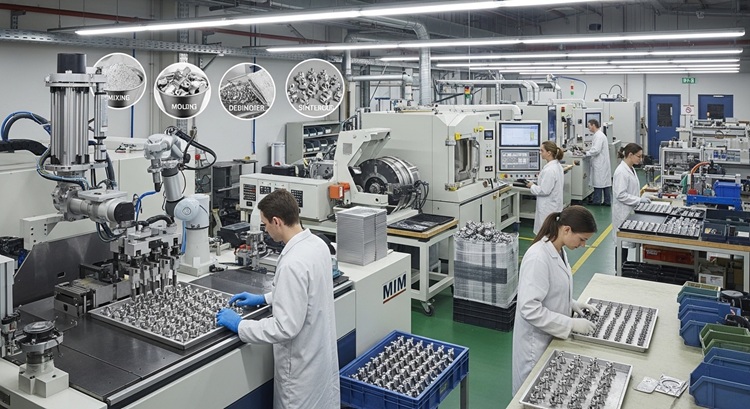
The question of what separates one MIM manufacturer from another is not, at first glance, an obvious one. The fundamental chemistry is the same everywhere: metal powder blended with binder, injected into a mould, debound, sintered, and inspected. The equipment categories are broadly similar. The quality management frameworks share common language. And yet the outcomes across producers vary in ways that matter enormously to the engineers and procurement teams who depend on consistent, high-integrity components at production scale. Understanding those differences requires looking past the surface similarities and into the specific decisions that each organisation has made about where to invest, what to prioritise, and how to manage the process variables that most other industries never have to think about.
The Illusion of Equivalence
There is a tendency, particularly among buyers encountering metal injection moulding manufacturers for the first time, to treat the process as a commodity. If the certification plaques look the same and the quoted tolerances fall within comparable ranges, the assumption is that the difference must come down to price. That assumption is expensive. MIM is a process in which small deviations in powder quality, binder composition, or sintering atmosphere can produce parts that pass dimensional inspection and fail under mechanical loading. The failures tend to be subtle, intermittent, and difficult to trace back to their origin by the time they are detected in the field.
Leading MIM parts manufacturers are distinguished precisely by their ability to control those subtle variables with a consistency that does not degrade under production pressure. That capability is built over years, through deliberate investment in materials knowledge, process instrumentation, and the kind of institutional discipline that keeps critical parameters from drifting when order volumes spike and furnace schedules tighten.
Where the Differences Are Built
Powder and Feedstock Mastery
The starting material in any MIM process is fine metal powder, typically with particle sizes below 20 microns, blended with a binder system that must flow predictably under injection conditions and leave the part completely during debinding. Leading metal injection moulding manufacturers exert control at this stage rather than accepting variability from external suppliers.
Producers who compound their own feedstock can adjust binder ratios, control powder loading precisely, and respond to batch-to-batch variation in raw powder without disrupting downstream processes. Those who rely entirely on purchased feedstock inherit the variability of their supply chain and have fewer options when something drifts. This is not a theoretical distinction. It is one of the most reliable predictors of long-run dimensional consistency across high-volume production.
Sintering Atmosphere and Thermal Control
If feedstock mastery is where leading producers start, sintering is where they separate themselves most decisively from the field. The sintering step, in which the debound part is heated to temperatures approaching the metal’s melting point and held there while particles fuse, determines the final density, microstructure, and mechanical properties of every component.
Atmosphere control is critical. Hydrogen, nitrogen, vacuum, and combinations of these environments each interact differently with the metal alloys being processed. The wrong atmosphere for a given material can introduce surface oxides, alter carbon content, or produce internal porosity that is invisible to standard inspection but catastrophic under fatigue loading. A leading MIM component manufacturer maintains multiple furnace environments, monitors them continuously, and retains the thermal process data as part of the production record for every batch.
Singapore’s MIM manufacturing sector has made particularly notable investments in vacuum and hydrogen sintering infrastructure, driven by the demands of the medical device and aerospace markets that form a significant part of the city-state’s advanced manufacturing base. That investment reflects a considered understanding of where process control translates most directly into product reliability.
Secondary Processing Integration
A comparison of MIM manufacturers that ends at sintering is incomplete. Most high-performance applications require post-sintering operations: precision CNC machining to achieve tolerances tighter than the MIM process alone can hold, heat treatment to develop specific mechanical properties, surface finishing for functional or aesthetic requirements, and in regulated industries, full documentation linking every secondary operation to the original material certification.
Leading producers either perform these operations in-house or manage them through tightly controlled supplier relationships with clear accountability. The distinction matters because every handoff between facilities introduces the possibility of traceability gaps, handling damage, or atmospheric contamination that affects surface integrity. A MIM parts manufacturer that controls the full process chain is offering something qualitatively different from one that sinters and ships.
Sector-Specific Experience
The applications served by the global MIM industry span an unusually wide range, from orthodontic brackets and surgical instruments to firearms components, automotive sensors, and precision electronics hardware. Each sector carries its own qualification standards, inspection protocols, and failure mode priorities.
What differentiates leading metal injection moulding manufacturers in this dimension is not simply the breadth of their application experience, but the depth of their understanding within specific sectors. A producer with genuine expertise in implantable medical devices understands biocompatibility standards, sterile packaging requirements, and the documentation burden of regulated markets in a way that cannot be acquired quickly. The same applies to aerospace, where material certification requirements and traceability obligations are non-negotiable.
Engineering Partnership Versus Order Fulfilment
Perhaps the clearest difference between leading and average MIM manufacturers is the role they are willing and able to play in the development process. Average producers execute drawings. Leading producers engage with the geometry before the drawing is finalised, identifying features that will cause problems during moulding or sintering, suggesting modifications that improve yield without compromising function, and flagging material choices that may not survive the process conditions required.
That kind of engagement requires metallurgical knowledge, process simulation capability, and a commercial culture that values long-term relationships over transactional efficiency. It is not universal. It is, however, the single most reliable indicator that a MIM manufacturer will still be performing at the required level three years into a production programme, not just during the qualification phase.

 Build Your Business With Creative Ideas - workin.business.blog