
The modern warehouse operates as a complex organism, and at its skeletal core lies the industrial pallet racking system, a structural innovation that has revolutionised how societies store and distribute goods across the globe. Much like how ancient civilisations developed granaries to support growing populations, today’s industrial facilities depend upon sophisticated racking infrastructures to maintain the flow of commerce. Understanding these systems requires examining not merely their physical properties, but the evolutionary pressures that have shaped their development and the diverse environments in which they function.
The Evolutionary Context of Warehouse Storage
Throughout human history, the challenge of efficient storage has driven technological adaptation. What began as simple wooden shelving has evolved into engineered steel frameworks capable of supporting tonnes of material whilst maximising vertical space. In Singapore, where land constraints mirror the geographical limitations that have historically driven innovation in densely populated regions, the adoption of advanced industrial pallet racking systems represents a logical response to environmental pressures. As one industry specialist notes, “Singapore’s warehouse facilities demonstrate storage densities that would have been unimaginable two decades ago, achieving up to 40% greater capacity through modern racking configurations.”
Primary Types and Their Adaptive Advantages
The diversity of racking systems available today reflects the varied demands of different storage environments, each type having evolved to solve specific logistical challenges.
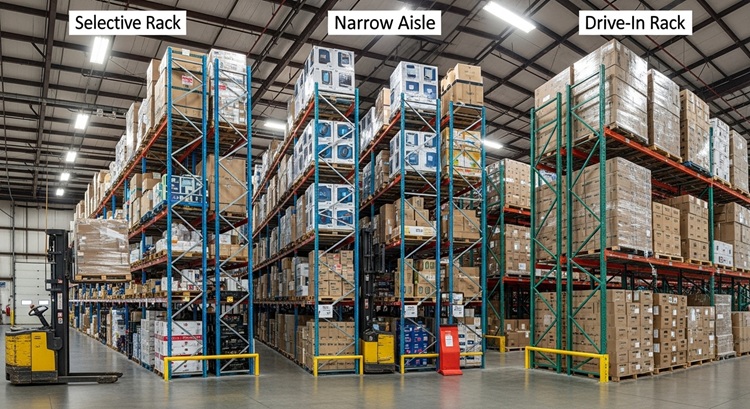
Selective pallet racking, the most widespread variant, offers direct access to every stored item. This system functions optimally in environments requiring frequent stock rotation, much as generalist species thrive in diverse ecosystems. Its characteristics include:
- Immediate access to all pallets without repositioning
- Load capacities typically ranging from 1,000 to 3,000 kilograms per level
- Straightforward installation and reconfiguration
- Efficient use of forklift operations
Drive-in and drive-through systems represent a contrasting strategy, sacrificing individual accessibility for maximum density. These configurations prove advantageous when storing large quantities of identical products, similar to how monoculture agriculture maximises yield per hectare whilst accepting reduced diversity.
Double-deep racking occupies a middle ground, achieving approximately 40% greater storage density than selective systems whilst maintaining reasonable accessibility. This compromise solution demonstrates how industrial storage systems, like biological organisms, often evolve towards balanced solutions rather than extreme specialisation.
Push-back racking introduces dynamic elements, utilising gravity and inclined rails to move pallets forward automatically as front positions empty. The elegance of this mechanism lies in its reduction of labour whilst maintaining good stock rotation, a principle of efficiency that would satisfy any systems theorist.
Critical Considerations for System Selection
Choosing appropriate pallet racking infrastructure demands careful analysis of multiple interconnected factors. The decision-making process parallels ecological assessment, where understanding the interplay between various elements determines success or failure.
Load capacity calculations form the foundation of any racking specification. Underestimating weight requirements can lead to catastrophic structural failure, whilst overengineering unnecessarily increases costs. Engineers must account for:
- Static load per pallet position
- Dynamic loads during placement and retrieval
- Seismic considerations in earthquake-prone regions
- Impact forces from forklift operations
Warehouse height represents another crucial variable. Singapore’s industrial facilities frequently feature ceiling heights between 9 and 12 metres, permitting four to six storage levels. However, maximising vertical space requires sophisticated material handling equipment and presents distinct safety challenges.
“The relationship between racking height and operational efficiency follows a curve rather than a straight line,” explains one warehouse design consultant. “Beyond certain thresholds, the time required for vertical travel diminishes the theoretical storage advantages.”
Safety Standards and Regulatory Frameworks
The implementation of industrial racking systems occurs within strict regulatory environments, particularly in developed markets like Singapore. These standards have evolved through painful experience, each requirement typically representing lessons learned from past failures. Regular inspections, load signage, and structural integrity assessments form essential components of responsible warehouse management.
Floor loading capacity deserves particular attention. A fully loaded racking system can exert tremendous concentrated pressure on concrete slabs, potentially exceeding design specifications if inadequately assessed. The consequences of floor failure extend beyond immediate structural damage to encompass potential injury and operational disruption.
The Future Trajectory of Storage Technology
Looking forward, warehouse pallet racking continues to evolve in response to changing commercial pressures. Automation increasingly influences design decisions, with systems specifically engineered to accommodate robotic retrieval mechanisms. The rise of e-commerce has accelerated demand for high-density storage combined with rapid picking capabilities, driving innovation in hybrid systems that balance competing requirements.
Climate considerations also shape contemporary racking design. Lighter-weight materials reduce embodied carbon, whilst modular designs facilitate reuse and reconfiguration rather than disposal. These adaptations reflect broader societal recognition that industrial infrastructure must operate within environmental constraints.
The trajectory of warehouse storage technology illustrates a fundamental principle observable throughout human history: faced with constraints, whether spatial, economic, or environmental, societies develop increasingly sophisticated solutions. The industrial pallet racking system stands as testament to this ongoing process of innovation and adaptation.


