
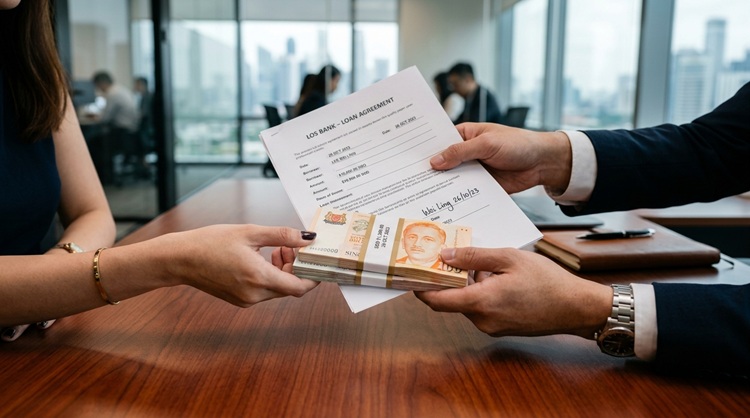
Interest is where most borrowers get confused, and the confusion is rarely accidental. A figure quoted per month sounds smaller than the same figure quoted per year, and a total repayable amount sounds larger than an instalment. Understanding how a licensed money lender interest rate is calculated in Singapore turns a vague sense of expense into a number you can check with a calculator, which is the only basis on which any loan should be accepted.
The Statutory Caps
Since 2015 the Ministry of Law has fixed the maximum charges a licensed moneylender may impose. Interest cannot exceed four percent per month. Late interest cannot exceed four percent per month and may only be charged on the amount actually overdue, not on the whole outstanding balance. A late fee is capped at sixty dollars per month. An administrative fee is capped at ten percent of the principal and may be charged once, at the point of disbursement. These are ceilings applying to every licensed lender, regardless of the borrower’s income or credit history.
Four Percent of What, Exactly
The rate applies to the outstanding principal, not to the original loan amount. As you repay, the principal falls and the monthly interest charge falls with it. This is a reducing balance calculation, and it produces a materially lower total than a flat rate applied to the opening balance every month. If a schedule shows an identical interest amount in month one and month six on an amortising loan, ask how it was derived, because on a reducing balance the later figure should be smaller.
A Worked Example
Take a three thousand dollar loan over six months. An administrative fee of ten percent means three hundred dollars is deducted at the start, so you receive two thousand seven hundred while owing three thousand. Interest accrues at up to four percent monthly on the falling principal, so the first month’s charge is around a hundred and twenty dollars and the last month’s is a fraction of that. Add the instalments together and compare the total against the three thousand you were credited with. That difference is your true cost of borrowing, and it is the only figure worth comparing between lenders.
The Total Cost Ceiling
Regulations also cap the aggregate. The sum of all interest, late interest, late fees and the administrative fee cannot exceed the principal of the loan. Borrow four thousand dollars and your total charges are capped at four thousand, no matter how long the loan runs or how many payments are missed. This ceiling is the single most important protection in the framework, and it does not exist at all in the unlicensed market, where balances are engineered to grow without limit.
Monthly Versus Annual
Four percent per month is not four percent per year. Compounded across a full year the effective figure is far higher, which is why short-term borrowing should genuinely be short term. A comparison against a bank’s advertised effective interest rate is not like for like unless both are converted to the same basis. When lenders are compared properly, the practical conclusion is usually that a licensed moneylender is the right tool for a small sum over a few months and the wrong tool for a large sum over several years.
What Drives the Rate You Are Offered
Within the cap, lenders differentiate. Income stability, the length of the term, the size of the loan and your repayment record all feed into the offer. A borrower with verified CPF contributions and a permanent employment contract will typically be quoted below the ceiling. Anyone quoting above four percent monthly, or charging fees beyond the four permitted categories, is operating unlawfully, and the correct response is to check the Ministry of Law’s register and walk away. Every legitimate money lender interest rate sits inside those boundaries.
Late Payment Arithmetic
The late-payment structure is narrower than most borrowers assume. If an instalment of five hundred dollars is missed, late interest applies to that five hundred, not to the entire remaining balance. Add the monthly late fee and the cost of one missed payment is quantifiable rather than catastrophic. It is still worth avoiding, and the cheapest way to avoid it is to tell the lender before the due date if money will be short, since a rescheduled payment costs nothing while a missed one does. Keep in mind that the sixty dollar fee is monthly rather than per instalment, so two missed payments inside the same month attract one fee, not two.
Questions That Get Straight Answers
Ask for the total repayable in dollars, the amount you will actually receive after the administrative fee, the instalment amount and count, whether interest is on a reducing balance, and what happens if you settle early. A lender who answers all five without hesitation is one worth dealing with. Read the contract, insist that no field is left blank, and keep your copy. Understanding a licensed money lender interest rate properly is what turns a loan from something that happens to you into a decision you have made.


